Youtube Timothy Keller How to Be Born Again
Sir Tim Berners-Lee, a name that will be remembered down the ages every bit one of the greatest inventors of all time. He, almost unmarried-handily, adult one of the greatest tools for mankind since the invention of the printing press.
Tim Berners-Lee is the human being who created the World Wide Spider web. To give him his full official name, Sir Timothy John Berners-Lee, OM, KBE, FRS, FREng, FRSA, DFBCS. That's a lot of mail-nominals.
He is a British Computer Scientist who enabled a system to be able to view web pages, known as hypertext documents, through the Cyberspace.
He also serves as a Director of the World Wide Web Consortium, W3C.
W3C oversees the standards of the web. He, amongst other things, is very concerned with maintaining liberty of information and restricting censorship on the Internet.
Today the world has never been and so interconnected, and it has never been easier to access and share data. The World wide web has revolutionized the way nosotros communicate, work, and play to even a few decades agone.
Without Tim's groundbreaking piece of work, all websites, including our own, simply could not be.
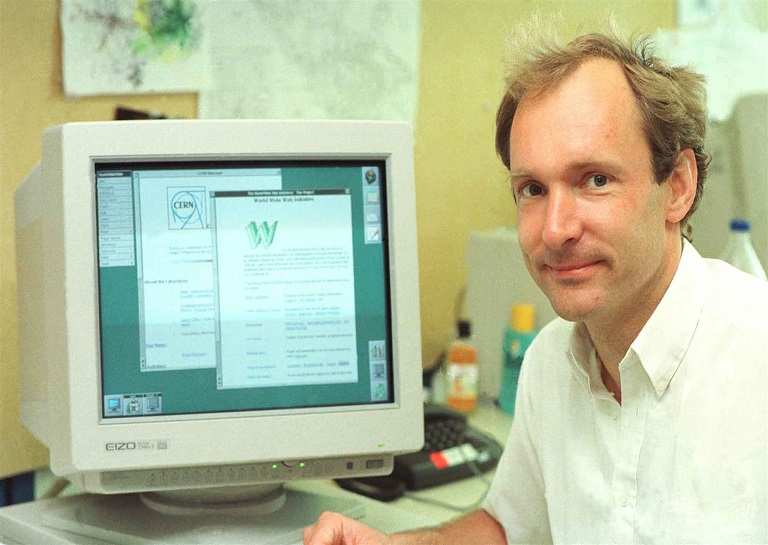
Early on years of the Www creator
Tim Berners-Lee was born on the 8th of June 1955 in London. He completed his A-levels at Emanuel School, subsequently which he went to Queens College, Oxford. At Oxford, he successfully completed his physics caste, gaining a first-class degree in 1976. Afterward his time at Oxford, he started working for a press firm in Plessy, Poole.
In 1980, He began working at CERN in Switzerland. His fourth dimension at CERN required him to share information betwixt researchers across the globe. Information technology soon became clear that they needed a means of sharing information electronically.
He suggested using hypertext, a language used for sharing text electronically, to do the job. With this in heed, he began to create his first prototype chosen Inquire.
The nascence of the Internet
Tim Berners-Lee is ofttimes cited as creating the Cyberspace, but the technology involved in it has been in development since the 1960s. His contribution was to build the Www. He introduced the concept of nodes and hypertext too as the thought of domains to the mix. These are critical elements of the World Broad Spider web that we know today.
Tim Berners-Lee himself has said of these early days, that all the engineering involved in the Internet was already in identify. His, non insignificant contribution, was to bring these elements all together in a coherent system. So it was in 1990, with the help of Robert Cailliau, that the first version of the Globe Wide Spider web was launched. Information technology came complete with the very first spider web page, web browser, and server.
This all ran on a NeXT computer at CERN.
Building the web
Every bit we take already seen, Berners-Lee is widely acknowledged as the creator of the World Wide Web, as we know information technology today. Berners-Lee, a British computer scientist, was working at CERN in Switzerland at the time, and in August of 1991, his first version of what would go the World wide web was born.
At that time in order for scientists at CERN to share and access information they needed to physically motility between computers. Berners-Lee realized this was far from efficient and it might be amend to form a network using the existing Cyberspace infrastructure of the time to do and then.
He realized that information could easily be shared using a 1960s applied science called hypertext. This was created by Ted Nelson in 1965.
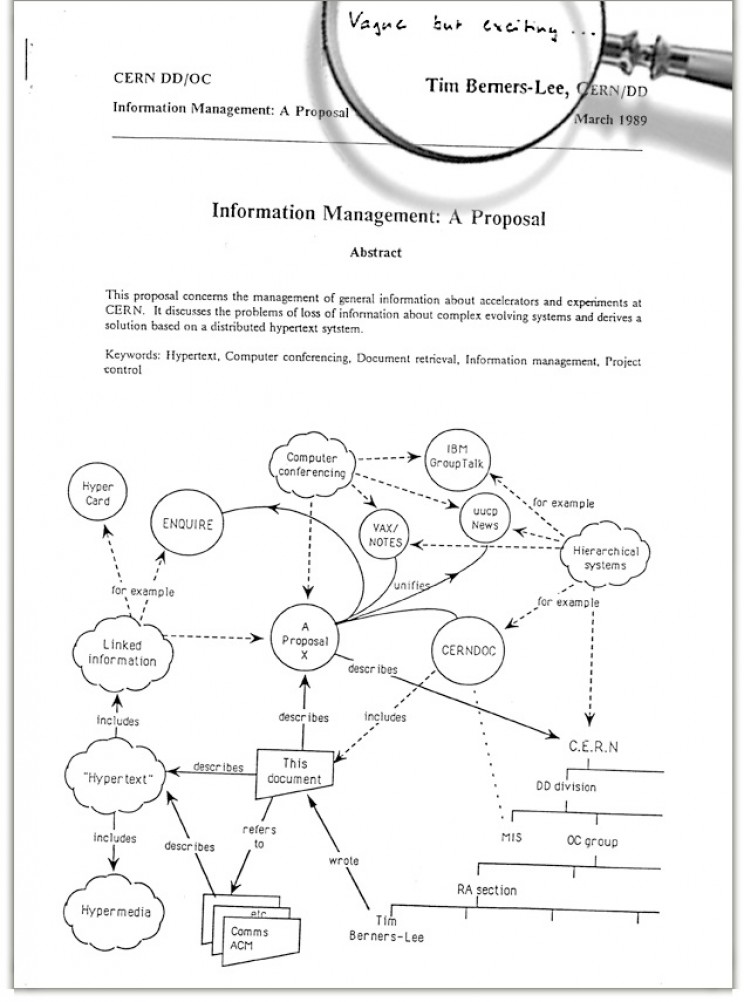
Berners-Lee proposed the idea to his boss in March of 1989 but, surprisingly, he wasn't that impressed. He fifty-fifty wrote, famously, that information technology was "vague only heady" on Berners-Lee's proposal.
Yet despite this minor setback, Tim Berners-Lee pressed alee with his plan. Scrounging time from his primary duties at CERN, Berners-Lee had managed, by 1990, to develop a prototype for his vision.
At this point in fourth dimension, he had created three elements that are vital to the Www today.
The prime elements of the World Wide Web were to make it easier for people to view hypertext web pages anywhere in the earth. This required a universal system for recognizing the location of web pages (URI (uniform resources identifier, which we at present call URL (Uniform Resource Locator ))
The system as well needed to have a standard language for published web pages (Hypertext Markup Linguistic communication - HTML). Lastly, a method of "serving up" web pages on asking was required (Hypertext transfer protocol - HTTP). Equally Tim Berners-Lee himself says on the matter:-
"I just had to take the hypertext thought and connect it to the TCP and DNS ideas and — ta-da!— the World Wide Web."
Tim Berners-Lee helped plant the W3C in 1994 at the Laboratory of Informatics (LCS) at MIT, Boston.
W3C had 1 simple, if not critically important role, to try to improve the quality and standard of the Globe Wide Web. Such a groundbreaking cosmos could hands accept made him a very rich man. Seeing the potential for the future of humanity he offered it to the globe with no patent or royalties of any kind.
That's incredibly generous.
Soon afterwards, the world'southward very start web page had been created, and past 1991 it was public to anyone with an Cyberspace connectedness. This event would kick-start an explosion in websites around the world.
By 1993, 130 websites were in existence, and past 1993 this had increased 5-fold to over 620. By 1994, co-ordinate to MIT, this had grown exponentially to around 2,700 sites including Yahoo! and Amazon.
Not long afterwards this had grown to around650,000,and today there are millions, if not billions of websites effectually the earth.
How did Berners-Lee bear on the world?
Berners-Lee, by developing the World wide web as we know it today, revolutionized the way humans communicate and share information with each other.
It is arguable that this development has been the most significant to mankind since the invention of the printing press in the 15th Century.
Simply like the press press centuries before it, the Www has provided an unprecedented platform for individuals to share their thoughts, build businesses, and access the unabridged back catalog of human being knowledge - all at their fingertips.
It, in no small-scale part, has gear up mankind on a path to the side by side phase in our technological evolution. Many consider the Globe Wide Web to be the goad for the current phases of the Information Age then-called 4th Industrial Revolution.
This actually can't be emphasized enough. Never before in human history has information technology been and so like shooting fish in a barrel to become information, communicate with other people effectually the world, and/or starting time a business of your very ain.
For artisans, the World Wide Web has provided a means for them to share their own work and bypass traditional roadblocks like publishers, record labels and art galleries/dealers.
As an artist you can know freely share your creations on whatever platform you wish and, if desired, monetize it.
Just as the printing press wrenched the control of information from the land and church building, so too has the Globe Wide Spider web provided a vehicle for the people to control what they see and share. Oft to the frustration of those who would adopt information technology otherwise.
The printing press opened the door for some of the greatest developments in thought in the world. For example, the Protestant Reformation, and, in its wake, the Scientific Enlightenment that followed.
Without the printing press, the modern world would exist a very different place indeed. It is exciting to think what the development of the World Wide Web will foster in the near and distant future.
So long as it remains free of authoritarian interference of course. For this reason, leading thinkers similar Tim Berners-Lee take long argued for an Internet Pecker of Rights to preserve the Internet and World Broad Web as a public infinite free from censorship and country command.
Such a pecker, if it could be passed, would strive to protect and provide:
- Accessibility,
- Affordability,
- Privacy,
- Freedom of expression,
- A diverse, decentralized and open platform and,
- Net neutralityfor users and content alike.
Berners-Lee has emphasized the need for Cyberspace users to drive its [the Net] direction. He is no stranger to voicing his concern over governments increasingly deny Internet users' rights to privacy and freedom; they must engage in debate, action, and protest.
"I believe nosotros tin build a Web that is truly for everyone: i that is accessible to all, from whatsoever device, and 1 that empowers all of usa to achieve our nobility, rights, and potential every bit humans." - Tim Berners-Lee
What the future has in store for the World Broad Web is anyone's guess, but there is no doubt it has been one of mankind'southward greatest inventions.
Why was the invention of the Earth Wide Spider web of import?
As we accept already seen, the Globe Broad Spider web has freed upward information exchange between people effectually the world. It has enabled anyone with an Internet connectedness the power to access a wealth of information, to freely communicate within anyone else on the web, and, if they desired, beginning their ain business organization or platform.

It has revolutionized many aspects of homo lives and opened up entirely new industries never earlier dreamed off. Yous can video phone call your friends and family the other side of the earth in existent-fourth dimension, play branch games with other people y'all've never met, and send letters and eastward-mails to recipients within seconds.
Any and all of this would seem like 'magic' to generations past. For many, the World wide web was but the start of something much bigger to come up.
If claims about the 4th Industrial Revolution have whatever existent weight, then the futurity of piece of work (and everything) will become unrecognizable to even a few decades ago. For improve or worse, the world of work volition probably never exist the same once more.
But like whatsoever revolution in technology throughout history, and equally the adage goes "when one door closes, some other opens", many jobs will get obsolete, only in their wake, new opportunities will rise.
Chosen 'Creative Destruction' past some economists, the appearance of things like IoT, AI, and Machine Learning promises to give mankind more gratis time to pursue their hopes and dreams, and hopefully, make some coin out of it.
But like all predictions of the futurity, only time will tell.
A gift for u.s.a. all
Tim Berners-Lee believes if he hadn't, someone else would have come upward with it further down the line. It is not unusual to find him referencing others who were involved in the creation of the Globe Wide Web.
There tin can be no doubt, yet, that Tim Berners-Lee'south work was instrumental in giving the world a gratuitous, open source information sharing service that we all love and cherish today.
Marc Andreessen, who helped him create his vision, sheds some more light on Tim's objectives with the web.
"Only smart people could employ the Internet, was the theory, and so nosotros needed to go on it hard to use. We fundamentally disagreed with that: we thought information technology should be piece of cake to use." Marc told The Guardian.
Tim Berners-Lee's net worth is reportedly $50M by 2019.
Net neutrality must be dedicated at all costs
Tim Berners-Lee has often been very song and aggressive in his defense of liberty of data and net neutrality. Rightfully so, he is adamant that governments must not be involved in censorship on the web. He is very concerned with the US'south seeming effort to produce a two-tier Internet system.
"When I invented the spider web, I didn't have to inquire anyone'southward permission. Now, hundreds of millions of people are using it freely. I am worried that that is going terminate in the USA." - Tim Berners-Lee
In 2009, Tim Berners-Lee worked with the then UK Prime Minister Gordon Chocolate-brown to aid make United kingdom data publically bachelor. He has often stated the importance of improving communication betwixt people around the world.
"The web is more than a social creation than a technical ane. I designed it for a social issue — to help people piece of work together — and not as a technical toy." - Weaving the Spider web, 1999.
Honoring the creator of the Earth Broad Web
Tim Berners-Lee'due south achievements have been recognized both officially and unofficially over the years. He has received many honors in the U.k. including an OBE, Knighthood and Society Merit. This makes him i of only 24 living members with this honor. He was knighted in 2004 "for services to the global development of the Internet."
He became ane of the first three recipients of the Mikhail Gorbachev Award for "The Man Who Changed the Globe". The inaugural ceremony was held in 2011 in London. Time Mag even listed Tim Berners-Lee equally one of the top 100 influential people on the 20th Century.
"He wove the World wide web and created a mass medium for the 21st century. The World Broad Web is Berners-Lee's alone. He designed information technology. He loosed it the earth. And he more than anyone else has fought to keep it open, nonproprietary and free." - Time Magazine
What does Berners-Lee practise now?
Y'all might well wonder what Berners-Lee has been up to since his cracking invention back in the 1990s. Well, as it turns out, he hasn't been idle.
Since the dawn of the web, Berners-Lee has been the Director of the Www Consortium, W3C.
Berners-Lee is as well the Director of the World Broad Web Foundation which was launched in 2009 to coordinate efforts to further the potential of the Web to do good humanity. He is a founding Director of the Spider web Scientific discipline Trust (WST), too launched in 2009, to promote research and education in Web Science, the multidisciplinary written report of humanity connected by engineering.
In 2001 Berners-Lee also became a Fellow of the Purple Gild. He is also the recipient of several international awards including a knighthood in 2004 by H.Chiliad. Queen Elizabeth, and in 2007 he was awarded the Social club of Merit.
Tim Berners-Lee is also currently a professor of information science at theUniversity of Oxford andthe Massachusetts Institute of Technology (MIT).
In 2012, Tim Berners-Lee was recognized as the inventor of the web at the Summer Olympics opening ceremony. His modesty was rampant even then tweeting that "this is for everyone".
His invention has changed the globe every bit we know it. He could so hands have monetised it but chose instead to gift it to all of us. You could contend that this act of incredible philanthropy has paid dividends in the long run for him.
Source: https://interestingengineering.com/how-did-tim-berners-lee-change-the-world-with-the-world-wide-web
0 Response to "Youtube Timothy Keller How to Be Born Again"
Post a Comment